Why SRD Stays at R370 — The Sassa Basic Income Debate Explained
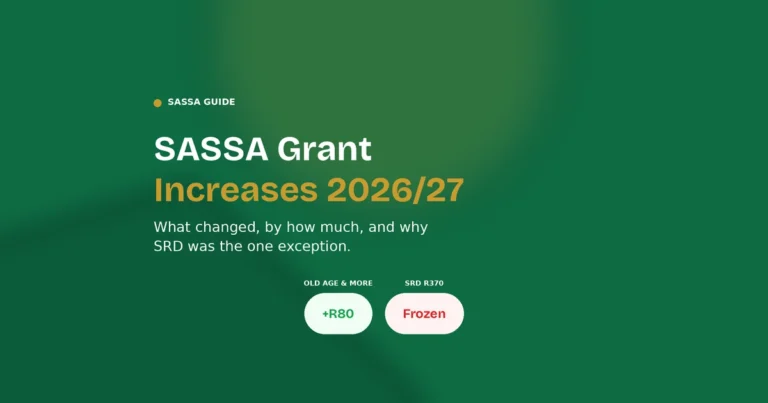
The SRD grant has paid R370 a month for three years running, even as every other SASSA grant received an increase in 2026. Here’s the context behind that number, and what might replace it.
- The R624 Threshold — and the R796 Reality
- What Civil Society Has Said
- The Livelihoods Support Grant Proposal
- The Timeline So Far
- Treasury’s Cost Concerns
- What Happens After March 2027?
- FAQs
- Final Thoughts
The R624 Threshold — and the R796 Reality
R370 sits well below South Africa’s means test threshold of R624 per month — the income limit SASSA set in 2022 as the eligibility boundary for the SRD grant. But the actual food poverty line (the minimum amount Stats SA calculates as needed for basic nutritional needs) has since risen to R796 per month as of 2026 — meaning even the R624 threshold is now below what is considered bare-minimum food costs. Civil society organizations have called for the SRD amount to be raised to at least R624, but the more accurate measure of the shortfall is the gap between R370 and R796 — a difference of R426 every month.
What Civil Society Has Said
Advocacy groups have pointed out that while seven of SASSA’s eight grant types received above-inflation increases in the 2026 budget, the grant reaching the country’s poorest and most economically vulnerable adults was the one exception. The frustration isn’t just about the amount staying flat — it’s about the gap between R370 and what’s actually needed to meet basic needs continuing to widen as the cost of living rises.
The Livelihoods Support Grant Proposal
President Ramaphosa confirmed at the 2026 State of the Nation Address that government will redesign the SRD grant “to more effectively support livelihoods, skills development and work opportunities” — language that has now replaced the earlier generic “Basic Income Support (BIS)” framing in official communication, though many people still refer to the proposal by that older name. The emerging design links financial support more closely to job-seeking activity, skills training, and employment pathways, rather than functioning as an unconditional payment to everyone who currently qualifies under SRD’s rules.
The Department of Social Development’s public consultation on the new design closed on 30 April 2026. Costing models have reportedly already been finalized following a draft framework submitted to Cabinet, and pilot programmes connecting Child Support Grant recipients to livelihood opportunities are already running in Gauteng, KwaZulu-Natal, and the Free State.
The Timeline So Far
As of mid-2026, the process has a more concrete shape than it did earlier in the year:
- July 2026 — National Treasury expected to confirm whether it supports the proposed framework
- If supported, August 2026 — Cabinet asked to approve the draft for public comment
- Following public input — a final version goes back to Cabinet
- March 2027 — targeted final Cabinet approval
- After that — amendments to the Social Assistance Act would still be required before the grant could actually become law
Worth knowing: a change in leadership at the Department of Social Development has added some uncertainty to this timeline, and an interim minister is currently overseeing the process. Even on a smooth run from here, this means the Livelihoods Support Grant would not replace SRD immediately, even after March 2027.
Treasury’s Cost Concerns
A universal, no-conditions basic income for all unemployed adults would be extremely costly at national scale. Treasury has previously flagged this directly, which is why the emerging design is expected to retain specific eligibility criteria — such as active job-seeking or skills-development requirements — rather than function as an unconditional payment to everyone who qualifies under SRD’s current rules.
What Happens After March 2027?
SRD funding is currently confirmed only through 31 March 2027. Given the legislative steps still required even after Cabinet approval, the Department of Social Development has indicated it may seek a further extension of SRD itself beyond that date specifically to avoid any interruption in support while the new framework’s legal process plays out. In other words, the most likely outcome is continuity — either SRD extended again in its current form, or a smooth handover once the new grant is legally in place — rather than a sudden gap in support. We’ll update this page as soon as anything is officially confirmed; there’s no need to take any action now, since your current SRD application and payments are unaffected by this ongoing policy discussion.
FAQs
- Why hasn’t the SRD grant increased? The 2026 budget prioritized extending SRD’s funding period over raising the amount.
- What is the food poverty line in South Africa? The actual food poverty line as calculated by Stats SA is R796 per month as of 2026. The R624 figure is the means test income threshold SASSA set in 2022 — which has not been updated to match the rising food poverty line, meaning the gap between the two has grown since the threshold was set.
- What is the Livelihoods Support Grant? The proposed permanent replacement for the temporary SRD grant, linking support to job-seeking and skills development — the same proposal many people still know as Basic Income Support (BIS).
- When will it replace SRD? No confirmed date — even with a smooth approval process, legislative steps mean it wouldn’t happen immediately after the targeted March 2027 Cabinet approval.
- Could SRD be extended again beyond March 2027? Yes — the Department of Social Development has indicated this is possible specifically to avoid a gap in support while the new framework’s legal process completes.
- Does this affect my current SRD payments? No — this is a policy discussion about the future; your current grant continues as normal.
Final Thoughts
R370 remains well below both the R624 means test threshold and the actual R796 food poverty line, and that gap is the core of the ongoing debate. The proposed Livelihoods Support Grant — what most people still call Basic Income Support — now has a more concrete timeline than before, but it still involves several more approval steps and a legislative process even in the best case. Nothing about your current SRD application or payments changes because of this discussion, and we’ll update this guide as soon as anything is officially confirmed.
For the full SRD grant picture, see our SRD Grant Overview; for what else changed in the 2026/27 budget, see our Grant Increases guide.